

- Uğur KOCABAŞ
- Primus inter pares.
Recent posts
View all
Greece’s Ukrainian Boost: Is the Hellenic Navy on the Verge of a Technological Leap?
The Hellenic Navy, seeking to inject fresh capability into its aging fleet through the induction of BELHARRA-class frigates, appears to have identified an expedient, economical, and rapid pathway to narrow its gap in the realm of Armed Unmanned Surface Vehicles (A-USVs) . According to reports, Greece has concluded a “classified” agreement with Ukraine involving the co-development and co-production of unmanned maritime systems that have already demonstrated effectiveness in active combat. News of this cooperation was received ent…

From SANCAR to Katran: A Roadmap for Unmanned Surface Systems
Following MARLIN and SALVO, the armed unmanned surface vessel SANCAR SIDA has officially been inducted into the Turkish Navy’s inventory.[1] Among the various contributions these platforms bring, what sets SANCAR apart is its integration into the ADVENT Network-enabled Combat Management System . For such a system to function effectively, a robust data network capable of supporting unmanned integration is required—a capability only a handful of countries can demonstrate in both their combat management systems and their datalink standardizat…

Greece’s Final Approach: Ambitions, Challenges, and Strategic Potential
Introduction On 15 September 2025 , after six years of construction and sea trials since October 2024, the French frigate Amiral Ronarc’h left the shipyard and sailed to her home port of Brest. Greece, closely following the program, hopes that the three sister ships still under construction at the same yard will become the new “Averof” of the Hellenic Navy—a flagship of national pride and deterrence. At the same time, Greece is setting ambitious goals: by 2030 , Athens intends to field the strongest navy in its modern history , whi…

A Quarter Away From Manned–Unmanned Teaming
In recent weeks, it was reported that the SALVO unmanned surface vessel (USV) , produced by DEARSAN, was delivered to the Turkish Navy.[1] Together with previously inducted unmanned systems, this represents another step toward the complex reality of manned–unmanned teaming at sea. Like all platforms, unmanned surface vessels will follow a traditional lifecycle for adaptation and integration. At first they will be employed in unit-level operations, then gradually integrated into naval task groups. Yet it would be a mistake to assume this…

Copy-Paste Unmanned Surface Vessel Attack by Russia
Last October, Ukraine carried out an attack on Russian naval forces near Sevastopol using its innovative unmanned surface vehicles. Although this offensive did not result in any deadly losses, it marked many firsts and took its place in naval history. Additionally, it seriously limited the operational freedom of the Russian fleet. Following the huge impact of this operation, Novorossiysk Naval Base and Fuel Terminal were targeted in a similar way once again in November 2022. After the attack on this port which is located about 400 na…
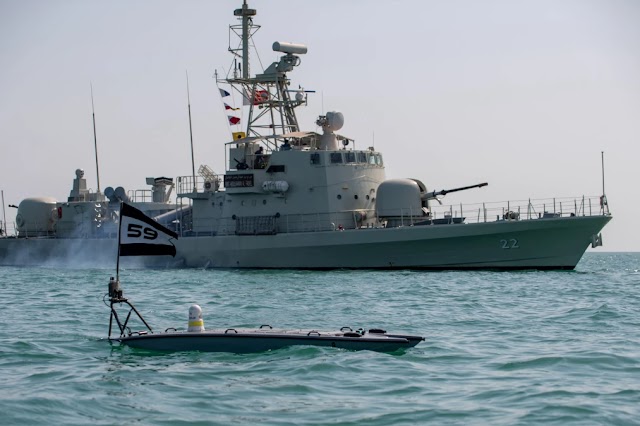
A Perfect Template for Unmanned Surface Vehicle Development Roadmap: Task Force-59
Task Force 59 (TF-59), established in Bahrain as the world's first operational afloat robot fleet, has achieved full operational capability in January 2023. The achievement of this capability just 15 months after its establishment was highlighted in the announcements, with TF-59 being the first in this field. Task Force 59 (TF-59), when its “Full Operational Capability” was announced, had already participated in 14 exercises, including three multinational, and its unmanned systems had carried out missions exceeding 25,000 operational hou…

Does Greece Really Want to Buy Second Hand Submarines?
Chief of the Hellenic Navy, Vice Admiral Petrakis delivered a speech, which covered detailed report about the activities of the Navy, on the occasion of the Patron of the Hellenic and Merchant Navy and Saint Nikolaos Day. Most of his speech covered navy routine, however, there were emerging bullets which clarified the future of the Navy in terms of its boosted arms race. In summary, Admiral Petrakis stressed the below topics: Belharra class frigates represent the future of the Navy, and day will be the decisive power for future con…


